Flow batteries

From Efficiency to Safety: Flow Batteries for Every Application

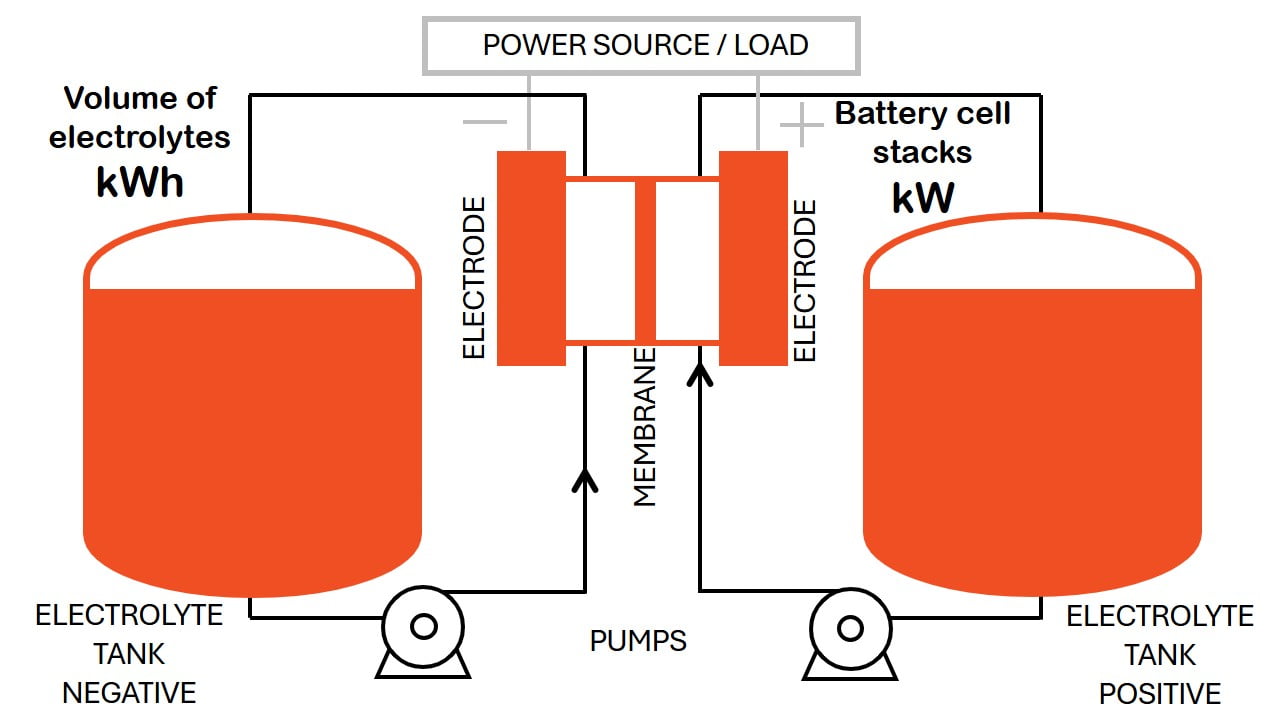
Flow batteries represent a cutting-edge solution for safe, efficient, and scalable stationary energy storage. One of the most significant advantages of flow battery technology is the decoupling of power (kW) and energy capacity (kWh). This modularity allows users to independently scale the system's power output and energy storage volume, making it highly adaptable to specific operational needs.

Flow batteries also offer high round-trip efficiency and extended operational lifetimes, even under frequent charge-discharge cycles. Unlike many conventional battery systems, they do not suffer from severe degradation over time, making them an economically sustainable choice for long-term deployments. Another key strength lies in their safety profile. Flow batteries typically use aqueous electrolytes, which are non-flammable, nonexplosive, and pose minimal environmental or fire risk. This makes them particularly attractive for use in urban areas, buildings, industrial sites, and remote installations where safety is a top priority.
flow-batteries1

A flow battery system consists of one or more electrochemical stacks connected to external electrolyte tanks. These tanks store the liquid electrolyte, which is pumped through the stack using circulation pumps and a network of pipelines. In typical configurations, the power output is defined by the size and number of stacks, while the energy storage capacity is determined by the volume of the electrolyte tanks. This separation allows for exceptional scalability and system flexibility.

flow-batteries2

Vanadium Flow Battery (VFB) Chemistry

Among all flow battery technologies, Vanadium Flow Batteries (VFBs) are the most commercially mature. They use an aqueous electrolyte containing vanadium in different oxidation states:

  • V²⁺/V³⁺ redox couple on the negative side
  • VO²⁺/VO₂⁺ redox couple on the positive side

These species are dissolved in sulfuric acid, enabling robust and reversible electrochemical reactions. During charging, V³⁺ is reduced to V²⁺, while VO²⁺ is oxidized to VO₂⁺. This elegant single-element chemistry avoids cross-contamination and contributes to the long cycle life and high reliability of VFB systems. As the field of flow batteries evolves, many scientists are actively exploring alternatives to vanadium, including iron, zinc, bromine, iodine, chromium, and various organic redox molecules.

Our Proven Process

We follow a structured, transparent workflow to ensure top-quality results every time.

Step One

We start with a deep analysis of your needs and objectives.

Step Two

Our team designs a custom solution tailored to your case.

Step Three

Implementation and testing of all required features.

Step Four

We support you post-launch with analytics and insights.