Non-Faradaic Electromembrane Processes

Non-Faradaic Electromembrane Processes

Non-Faradaic electromembrane processes are electromembrane operations in which the applied electric field drives ion transport, migration, concentration, or interfacial polarization, but the primary function is not a charge-transfer reaction at an electrode.

Important distinction

The term combines two concepts that are normally treated separately:

  • Electromembrane process: ionic transport through ion-exchange membranes caused mainly by an electric potential difference.
  • Non-Faradaic process: no net electron-transfer reaction is required for the observed process; current may instead arise from charging, polarization, adsorption, or ion redistribution.

Electromembrane processes are generally driven by electric potential and use membranes with fixed charged groups that selectively transport counter-ions.[1]
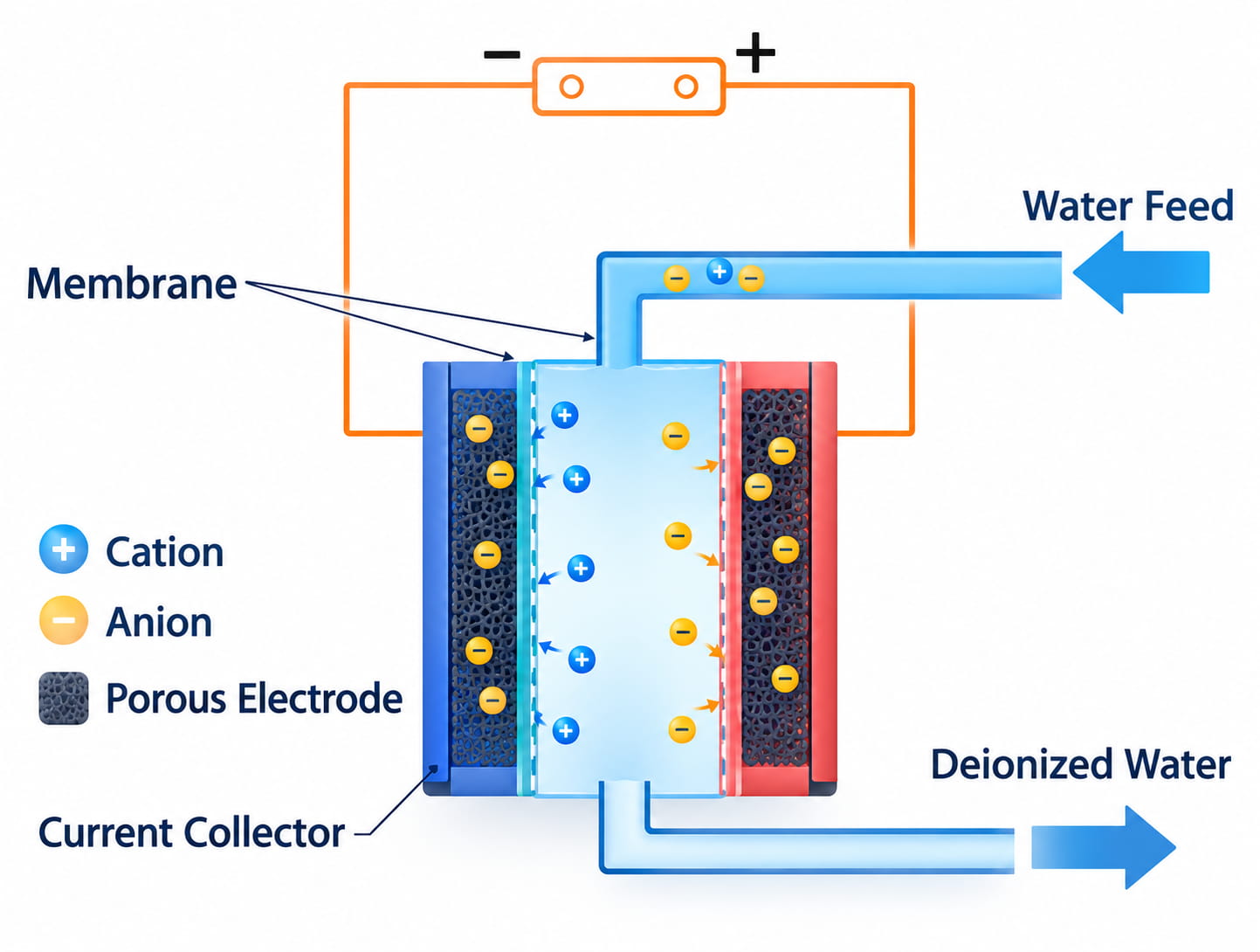
Diagram of membrane water deionization

Typical examples

Process Main mechanism Non-Faradaic character
Electrodialysis Cations and anions migrate through selective membranes Bulk ion transport is largely non-Faradaic; electrode reactions usually occur only in electrode compartments
Capacitive deionization Ions are electrosorbed into charged porous electrodes Strongly non-Faradaic during double-layer charging
Membrane capacitive deionization Electrosorption combined with ion-exchange membranes Mainly non-Faradaic ion storage and redistribution
Flow-electrode CDI Charged carbon slurry stores ions capacitively Non-Faradaic charge storage, although parasitic reactions may occur
Electrodeionization Electrodialysis combined with ion-exchange resin Ion migration and resin charge compensation dominate; water splitting can add Faradaic chemistry
Reverse electrodialysis Salt-concentration gradient generates ion transport and electrical power Membrane transport itself is non-Faradaic, with electrode reactions needed to close the external circuit
Electrodialysis with bipolar membranes Water dissociation produces H⁺ and OH⁻ Membrane water dissociation is not conventional electrode Faradaic transfer, though it is chemically reactive

Conventional electrodialysis, bipolar electrodialysis, electrodeionization, membrane capacitive deionization, and reverse electrodialysis are recognized families of electromembrane technologies.[2]

What physically happens?

In a non-Faradaic interfacial process, the electrode–solution interface behaves partly like a capacitor:

  1. An applied potential redistributes ions in the electrical double layer.
  2. Counter-ions accumulate near a charged electrode or membrane surface.
  3. Adsorption or desorption can change the interfacial structure.
  4. The measured current is associated with charging or ion redistribution rather than a stoichiometric redox reaction.

A transient current can therefore flow even without continuous electron transfer across the interface. Once the double layer is charged, the current ideally decays toward zero.[3]

For an ideal capacitive interface:

i = Cdl dVdt

where Cdl is the double-layer capacitance. In a flow-electrode or CDI system, the useful output is not necessarily a chemical product but the removal, concentration, or storage of ions.

Relevance to industrial systems

For flow batteries, electrochemical reactors, and water-treatment systems, “non-Faradaic electromembrane process” would usually refer to one of these functions:

  • selective ion transport without intentional membrane redox chemistry;
  • capacitive ion removal or concentration;
  • electrostatic control of membrane fouling or ion partitioning;
  • transient charging of membrane or electrode interfaces;
  • concentration-gradient-driven ion transport in reverse electrodialysis;
  • water dissociation at bipolar membranes, where the membrane—not a conventional electrode—is the active site.

A useful engineering description is therefore:

An electrically driven membrane process in which the desired separation or transport is achieved primarily by ion migration, electrostatic partitioning, or capacitive storage rather than by electrode charge-transfer reactions.

The qualification “primarily” matters: real systems commonly exhibit leakage currents, electrode reactions, water splitting, co-ion transport, and membrane degradation alongside the intended non-Faradaic mechanism.

Difference from Faradaic electromembrane operation

A practical electromembrane device often contains both mechanisms:

  • Non-Faradaic: ion migration through membranes, double-layer charging, electrosorption, polarization.
  • Faradaic: water electrolysis, electrode corrosion, redox-active species, chlorine evolution, oxygen reduction, or hydrogen evolution.

For example, in electrodialysis, salt ions migrate through the membrane stack, while water electrolysis at the electrodes supplies or consumes the current required to complete the electrical circuit. The membrane separation is not itself an electrode redox reaction.

This distinction is important because Faradaic current follows charge-transfer stoichiometry, whereas non-Faradaic current does not necessarily correspond directly to a chemical conversion rate. Adsorption and desorption can produce external currents without a sustained transfer of ions or electrons between bulk phases.[4]

Our Proven Process

We follow a structured, transparent workflow to ensure top-quality results every time.

Step One

We start with a deep analysis of your needs and objectives.

Step Two

Our team designs a custom solution tailored to your case.

Step Three

Implementation and testing of all required features.

Step Four

We support you post-launch with analytics and insights.