Welcome, Bronston — A New Chapter in Flow Battery Research
We are delighted to welcome Bronston Policard Benetho to Pinflow energy storage, s.r.o. as part of SPACER - Doctoral Network for Porous Electrode Architectures in Redox-Flow Batteries. Bronston joins Pinflow as a doctoral candidate focused on one of the most important challenges in next-generation redox flow battery development: understanding, characterizing, and optimizing porous electrodes faster and more reliably.

Bronston Policard Benetho

Doctoral Candidate · SPACER Network · Pinflow Energy Storage
Thesis topic: Fast characterisation and demonstration of optimised electrodes
Connecting Fundamental Research with Practical Engineering
At Pinflow, we believe that accelerating redox flow battery technology depends on keeping fundamental research closely connected to practical engineering. Bronston's doctoral project, titled "Fast characterisation and demonstration of optimised electrodes", fits this vision directly. His work will support faster evaluation of electrode materials and help shorten the path from promising laboratory discoveries to validated battery performance.
Redox flow batteries are a promising technology for long-duration energy storage. To realize their full potential, the industry needs a deeper understanding of how electrode structure influences efficiency, current density, and long-term system performance. Today, evaluating electrode candidates can be slow and resource intensive. Bronston's project tackles this bottleneck by developing a rapid screening approach for electrode materials and cell assemblies.
Fast Screening, Better Models, Stronger Batteries
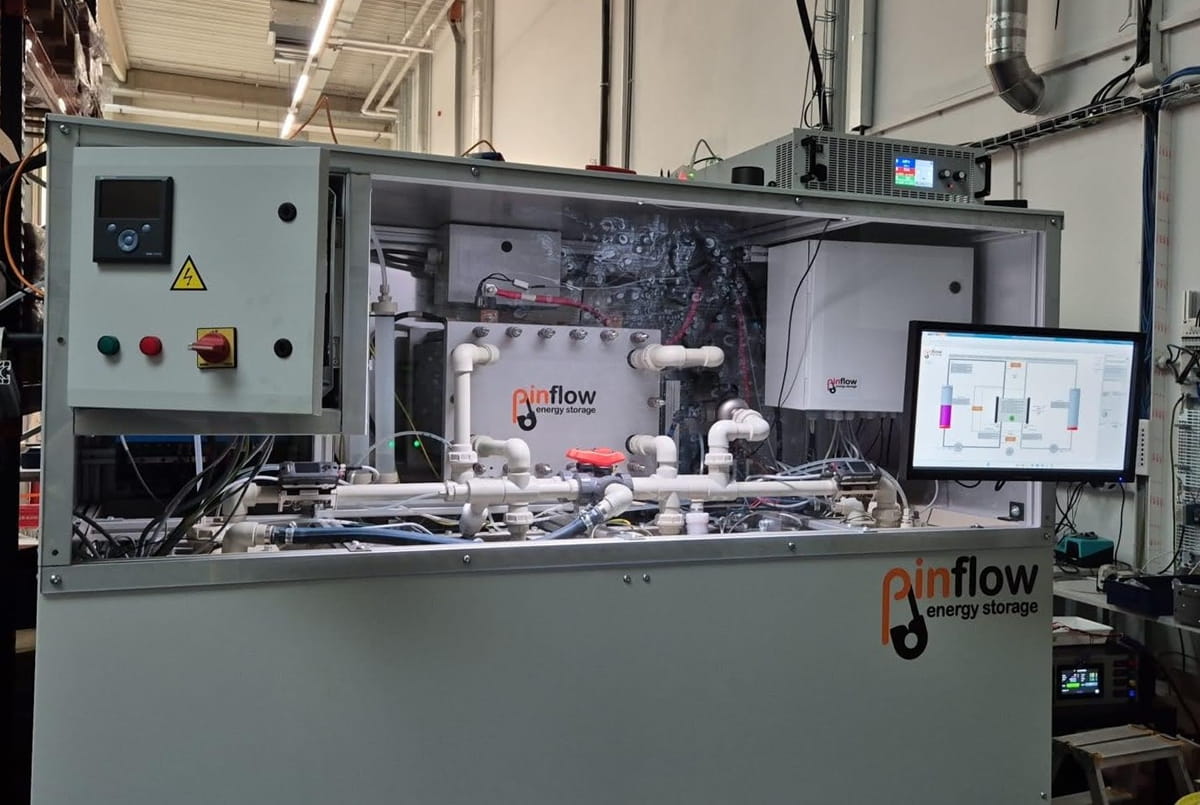
The project will focus on an innovative cell assembly designed for fast and reliable characterization across a wide range of electrode candidates. In parallel, computational fluid dynamics (CFD) models will be developed to describe how electrolyte flows and reacts inside different cell architectures. These models will help explain how porous electrode architecture affects performance and guide the rational design of optimized internal cell structures.
- Develop rapid screening methods for redox flow battery electrode candidates
- Improve understanding of how electrode structure governs battery performance
- Use CFD modelling to connect electrolyte flow, reaction behavior, and cell design
- Demonstrate full battery systems incorporating optimized electrodes
Part of Something Bigger: The SPACER Network
Bronston joins as one of 17 doctoral candidates recruited across 9 countries through the SPACER Doctoral Network — a Marie Skłodowska-Curie programme funded by the European Union. The network brings together 13 beneficiary partners and 8 associated partners, spanning leading universities and industry players with a shared mission: to make redox flow batteries more powerful, more efficient, and more affordable.
Pinflow leads Work Package 6 (Validation, Evaluation & Demonstration) within SPACER — the stage where science becomes technology. Bronston's project sits at the very heart of that mission.

Funded by the European Union (Grant Agreement no. 101226997). Views and opinions expressed are however those of the author(s) only and do not necessarily reflect those of the European Union. Neither the European Union nor the granting authority can be held responsible for them.